
The Idea That Changes Everything
There is a quote often attributed to Albert Einstein:
“Compound interest is the eighth wonder of the world. He who understands it, earns it. He who doesn’t, pays it.”
Whether Einstein actually said it or not, the idea is correct. Compound interest is quiet, invisible, and profoundly powerful — and most people underestimate it their entire lives.
This page explains what compound interest is, why it matters, and why starting early is one of the most important financial decisions you can make.
What Is Compound Interest?
When you put money into a savings account or investment, you earn interest — a return on your money. There are two kinds:
- Simple interest — you earn interest only on your original amount (the principal).
- Compound interest — you earn interest on your original amount plus on the interest you have already earned.
That second part is the key. With compound interest, your gains generate their own gains. Over time, this creates exponential growth.
The Formula
The compound interest formula is:
A = P × (1 + r/n)^(n×t)
Where:
- A = final amount
- P = principal (initial investment)
- r = annual interest rate (as a decimal)
- n = number of times interest compounds per year
- t = time in years
For annual compounding (n = 1), this simplifies to:
A = P × (1 + r)^t
Seeing It in Action
The best way to understand compound interest is to see it. The chart below shows what happens to $1,000 invested at a 7% annual return over 30 years — comparing compound and simple interest side by side.
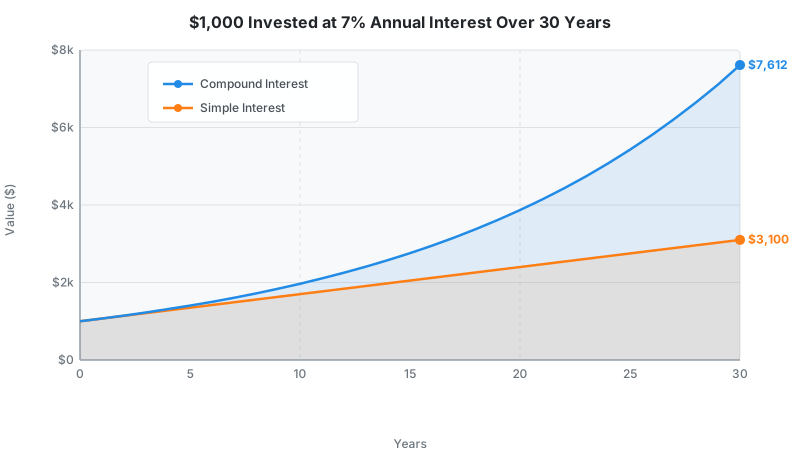
The result after 30 years:
| After 10 Years | After 20 Years | After 30 Years | |
|---|---|---|---|
| Simple Interest | $1,700 | $2,400 | $3,100 |
| Compound Interest | $1,967 | $3,870 | $7,612 |
With simple interest, you gain $70 per year — always the same amount. With compound interest, the gains grow every single year because the interest itself earns interest. The difference starts small and becomes enormous.
The Most Important Variable: Time
Compound interest rewards patience above all else. The longer you stay invested, the more powerful it becomes.
This is why starting early matters so much more than investing more.
The chart below illustrates this with two hypothetical investors, both earning a 7% annual return:
- The Early Bird invests $2,400 per year for just 10 years (ages 25 to 34), then stops completely.
- The Late Starter invests $2,400 per year for 30 years (ages 35 to 64), three times as long.
Both stop at age 65. Who comes out ahead?
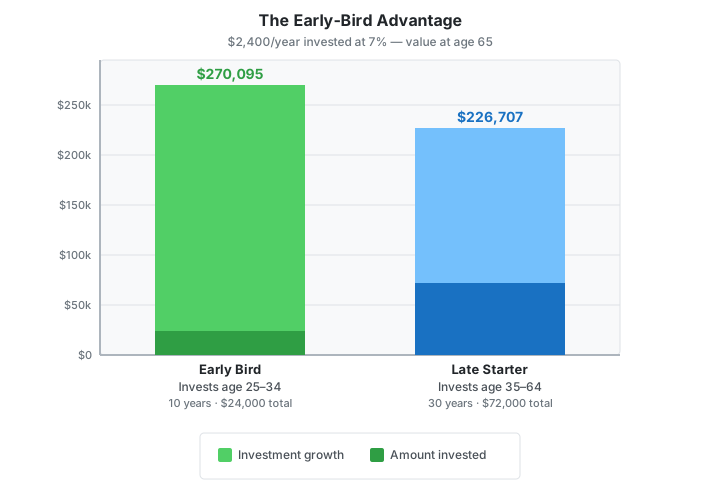
The Early Bird invested $24,000 total and ends up with $270,095 at age 65.
The Late Starter invested $72,000 total — three times as much — and ends up with $226,707.
The person who invested less money ends up with more — simply because they started a decade earlier.
This is the power of time in compounding. The early years of growth become the foundation on which all future growth is built.
The Rule of 72
A useful mental shortcut: divide 72 by your annual interest rate to estimate how many years it takes for your money to double.
| Annual Return | Years to Double |
|---|---|
| 4% | 18 years |
| 6% | 12 years |
| 8% | 9 years |
| 10% | 7.2 years |
| 12% | 6 years |
At 7%, your money doubles roughly every 10 years. Over 30 years, it doubles approximately three times — turning $1,000 into $8,000. That lines up closely with the $7,612 figure we saw in the chart above.
Compound Interest Works Against You Too
The same force that grows wealth can just as powerfully destroy it.
Credit card debt at 20% annual interest doubles in about 3.6 years. A $5,000 balance left unpaid for 10 years at 20% interest grows to over $30,000.
High-interest debt is compound interest working in reverse — every month you don’t pay it down, the balance grows and the problem compounds.
The lesson: pay off high-interest debt as aggressively as you invest. The mathematics are equally powerful in both directions.
Practical Takeaways
- Start now, not later — Time is the most valuable input in the compound interest equation. Even a few years of delay has a surprisingly large impact.
- Be consistent — Regular contributions, even small ones, accumulate significantly over decades.
- Reinvest your returns — Let your interest earn interest. Avoid withdrawing gains early unless necessary.
- Avoid high-interest debt — Compound interest working against you is just as relentless as when it works for you.
- Think in decades — The most dramatic effects of compounding happen in the later years. Trust the process.
Beyond Finance
The principle of compounding is not limited to money. It applies everywhere:
- Reading for 20 minutes a day builds a library of knowledge over years.
- Daily exercise compounds into dramatically better health over decades.
- Small improvements in skill compound into expertise.
“A 1% improvement every day for a year leaves you 37 times better than when you started.”
The same principle that makes compound interest so powerful in finance applies to every area of life. Start small. Stay consistent. Give it time.
For practical strategies on building that consistency, see The Power of Consistency: Small Steps, Big Results.
“The best time to plant a tree was 20 years ago. The second best time is now.” — Chinese Proverb